
Human intelligence manifests itself through a number of highly specialized but interrelated competences and skills. Assuming that the basis for these abilities is an extraordinary well-organized associative memory, information and knowledge modeling takes on a special position for Strong Artificial Intelligence also called Artificial General Intelligence (AGI). A lot of commercial software systems use basic information modeling techniques, like Entity Relationship Diagrams (ERD) or Uniform Modelling Language (UML), which has strengths but also weaknesses. Some techniques are designed to model more dynamical events like the Business Process Modelling Language (BPML). Further developed modeling techniques are used to describe information in a more sophisticated way and even used to model knowledge represented in computer systems and AI systems. One example is the Knowledge Modeling and Description Language (KMDL). This course provides three main topics: a) An advanced approache to structure information for intelligent systems. b) The modeling of different aspects like time and space within that information models in different ways. c) Development of a custom modeling language providing an orthogonal integration of the discussed aspects. d) Defining parsers to compile the languages into adequate information and knowledge structures. The learned techniques are used to model the dynamic movement of a robot within a room with no coordinate system, but only based on relative and spontaneously received position information of detected items.
- Dozent/in: Robert Grebner

- Dozent/in: Arndt Balzer
- Dozent/in: Andreas Lehrmann
- Dozent/in: Dominik Seuß
This 'course' is just an anchor point for the MAI study program
to communicate some information and to address common questions.
Please check also the announcements / Ankündigungen,
(in the upper part of the content list of this moodle course)
for information which has already been communicated before
you have enrolled / registered in this moodle course.
General (formal) information about the MAI study program
(SPO,module description a.s.o) can be found here:
https://mai.fhws.de/en/
- Dozent/in: Magda Gregorová
- Dozent/in: Frank-Michael Schleif

- Dozent/in: Arndt Balzer
- Dozent/in: Frank Deinzer
- Dozent/in: Magda Gregorová
- Dozent/in: Pascal Meißner
- Dozent/in: Frank-Michael Schleif
- Dozent/in: Martin Storath
This is a course on natural language processing, semantics and learning representations.
- Dozent/in: Ivan Yamshchikov

- Dozent/in: Bibin Babu
- Dozent/in: Magda Gregorová
- Dozent/in: Pascal Meißner
- Dozent/in: Frank-Michael Schleif
- Dozent/in: Bibin Babu
- Dozent/in: Franziska Königer
- Dozent/in: Pascal Meißner
- Dozent/in: Maximilian Münch
- Dozent/in: Frank-Michael Schleif
- Dozent/in: Magda Gregorová
- Dozent/in: Beate Müller
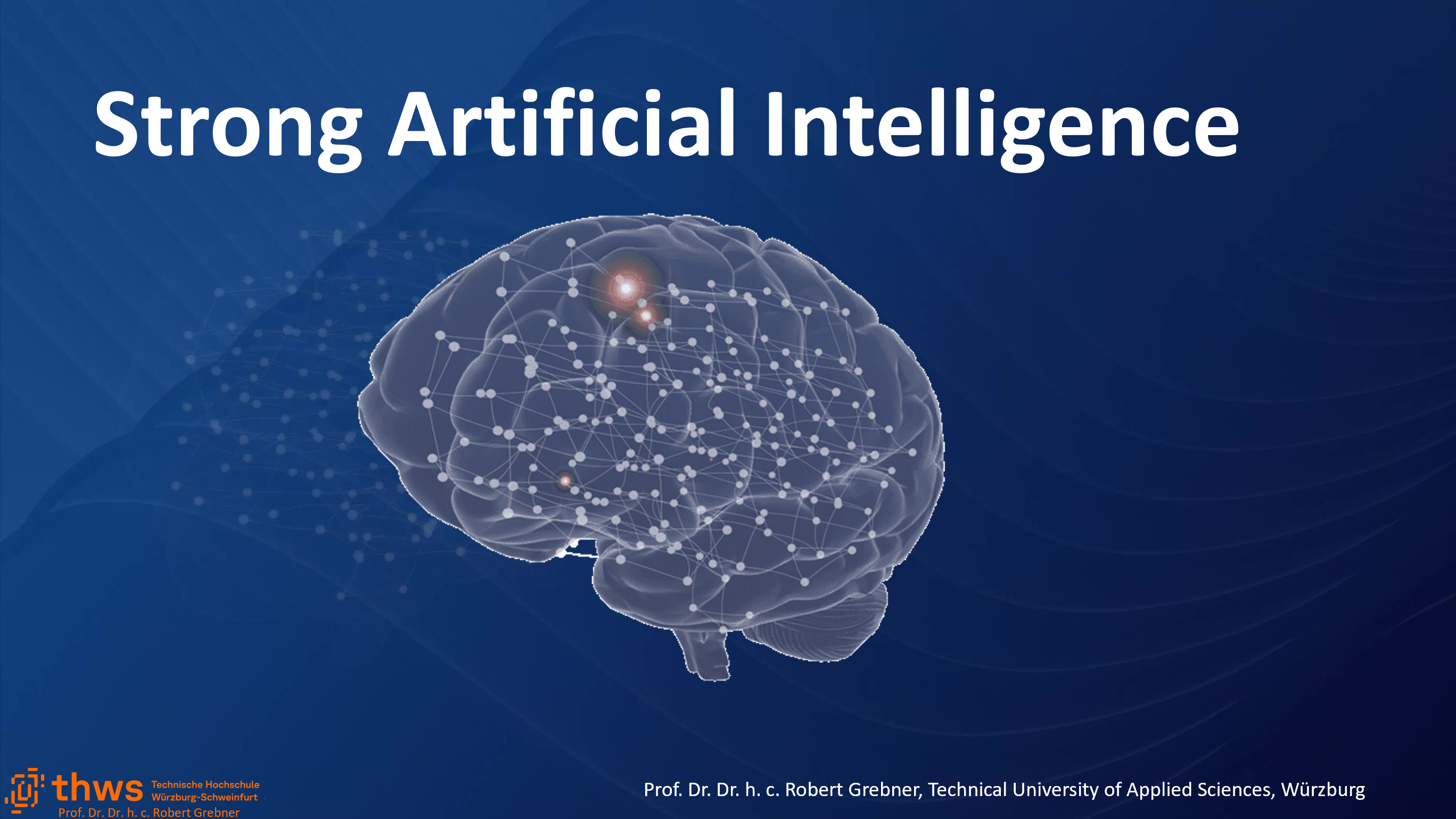
Strong artificial intelligence deals about the question how to design and build human like thought machines. In the course we elaborate the basics of human thinking including naming, numbering, abstracting, conceptualizing and what is needed to build a digital machine that is able to think and act like an individual and is able to interact with other individuals. A variety of interconnected and adopted concepts and theories are necessary to implement human like skills and behaviour. A selection of these, like theory of information, action, time and space as well as a theory of thinking is discussed and developed in the course.
- Dozent/in: Robert Grebner